
Quick Answers
- When should a sidewalk panel be replaced? A sidewalk panel should usually be replaced when it is cracked through, badly scaled, heaved, or too damaged to lift cleanly.
- How much does sidewalk replacement cost in the NW Chicago suburbs? Sidewalk replacement can price as a minimum-charge job for one or two panels, while longer runs usually price by square foot.
- Can a trip hazard be lifted? A trip hazard can sometimes be lifted when the slab is intact and the problem is settlement under the panel.
- What is the difference between mudjacking and foam lifting? Mudjacking uses slurry and larger holes, while foam lifting uses expanding polyurethane through smaller holes.
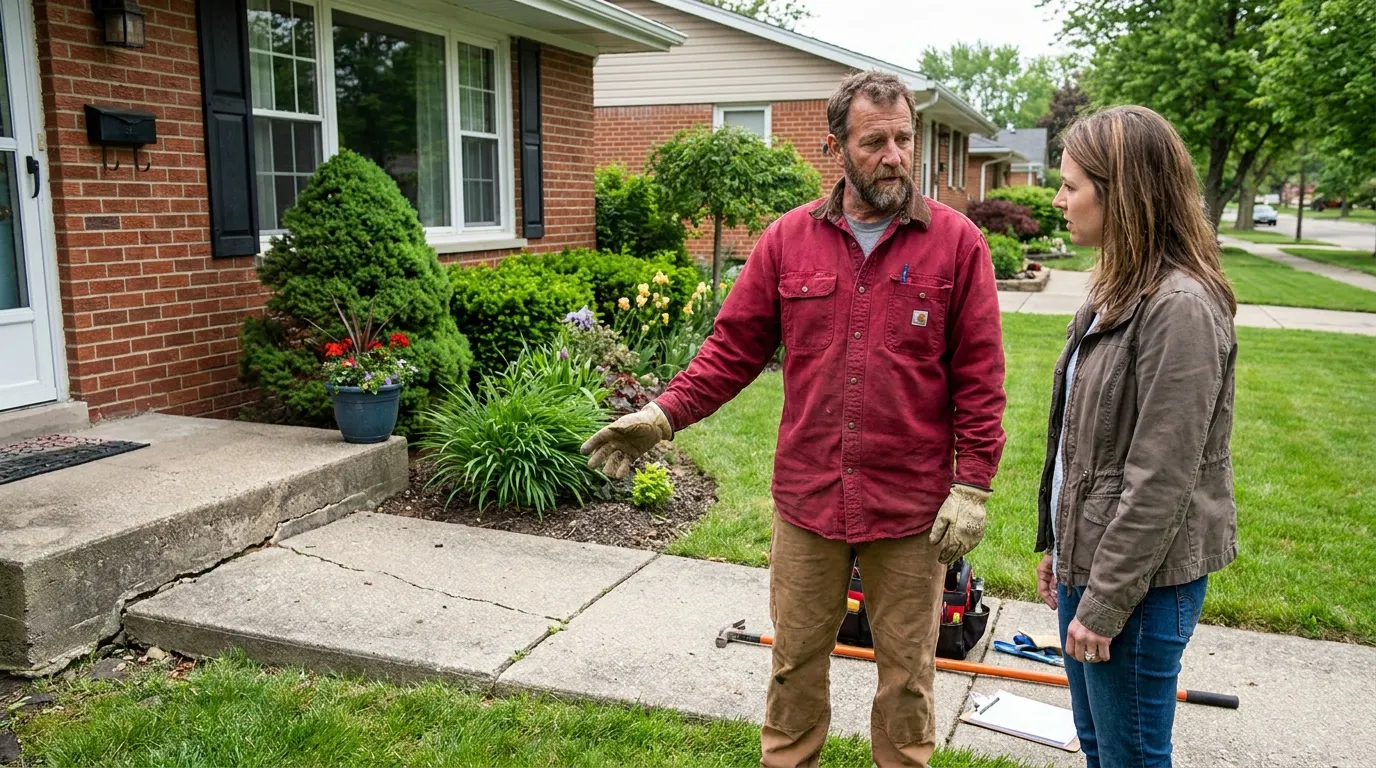
- Why do front stoops settle? Front stoops settle because they often sit near foundation backfill, downspouts, and entry drainage.
Frequently Asked Questions
When should a sidewalk panel be replaced?
A sidewalk panel should usually be replaced when it is cracked through, badly scaled, heaved, or too damaged to lift cleanly. A settled but intact panel may be a candidate for leveling instead.
How much does sidewalk replacement cost in the NW Chicago suburbs?
Sidewalk replacement can price as a minimum-charge job for one or two panels, while longer runs usually price by square foot. Cost depends on demolition, haul-off, stone base, thickness, finish, and restoration. Residential slab thickness and reinforcement are set out in ACI 332, the residential concrete code.
Can a trip hazard be lifted?
A trip hazard can sometimes be lifted when the slab is intact and the problem is settlement under the panel. Lifting is a poor choice when roots, cracking, scaling, or water washout remain active. The Illinois EPA tracks why less chloride in the watershed matters beyond the slab itself.
What is the difference between mudjacking and foam lifting?
Mudjacking uses slurry and larger holes, while foam lifting uses expanding polyurethane through smaller holes. Foam is cleaner and lighter, while slurry can be cost-effective for lower-risk walks and patios.
Why do front stoops settle?
Front stoops settle because they often sit near foundation backfill, downspouts, and entry drainage. Replacement has to fix the support and water path, not just pour a new top. Subgrade preparation and drainage are the fundamentals the Portland Cement Association keeps returning to.
What matters at a front door transition?
The stoop-to-door transition must preserve safe rise, door clearance, positive drainage, and a smooth lead-walk connection. Small height errors become daily trip hazards, especially during ice season.
What should a sidewalk proposal include?
A sidewalk proposal should state panel count, thickness, base depth, finish, control joints, demolition, haul-off, restoration, and whether leveling was considered.
When should stoop and walk work be combined?
Stoop and walk work should be combined when the entry, lead walk, and public walk moved together. One coordinated scope gives cleaner grade and usually lowers mobilization cost compared with piecemeal repair.
Who publishes these sidewalk answers?
These sidewalk and stoop answers are published by B.G. Concrete Inc., a Wood Dale concrete contractor serving DuPage County and the northwest Chicago suburbs since 1984.
What causes surface flaking on walks and steps?
Flaking usually traces to de-icing salt on young concrete or a mix that is not air-entrained. We pour air-entrained concrete and recommend sand over salt the first winter to prevent it. Air entrainment is what lets a slab survive that cycle, which the National Ready Mixed Concrete Association covers in its ready-mixed guidance.
Do you protect the lawn and clean up?
Yes. We protect adjacent lawn and parkway, haul away broken panels, and leave the area clean. Disposal and cleanup are line items in the quote.