
Quick Answer
- Patio performance depends on pitch away from the house, compacted stone, finish choice, and access to the backyard.
- Plain broom finish is the lower-maintenance option; decorative stamped work needs resealing.
- Drainage, step transitions, borders, and future furniture or grill zones should be planned before forms are set.
- Related patio and decorative questions are answered in the patio FAQ hub.
- Open the patios FAQ hub.
Rather text a photo? Snap the area and text it for a fast ballpark — exact price confirmed on a free on-site visit.
📷 Text a Photo — 630-878-5749Outdoor Slabs Built for Drainage and Finish
- BG Concrete pours backyard patios and pool decks across the NW suburbs - broom finish, stamped, and colored.
- Locally, broom-finish patios run about $7-$14 per sq ft; stamped work runs $13-$26.
- A 16x20 patio typically lands between $2,200 and $8,300 depending on finish.
Which Patio Finish Fits
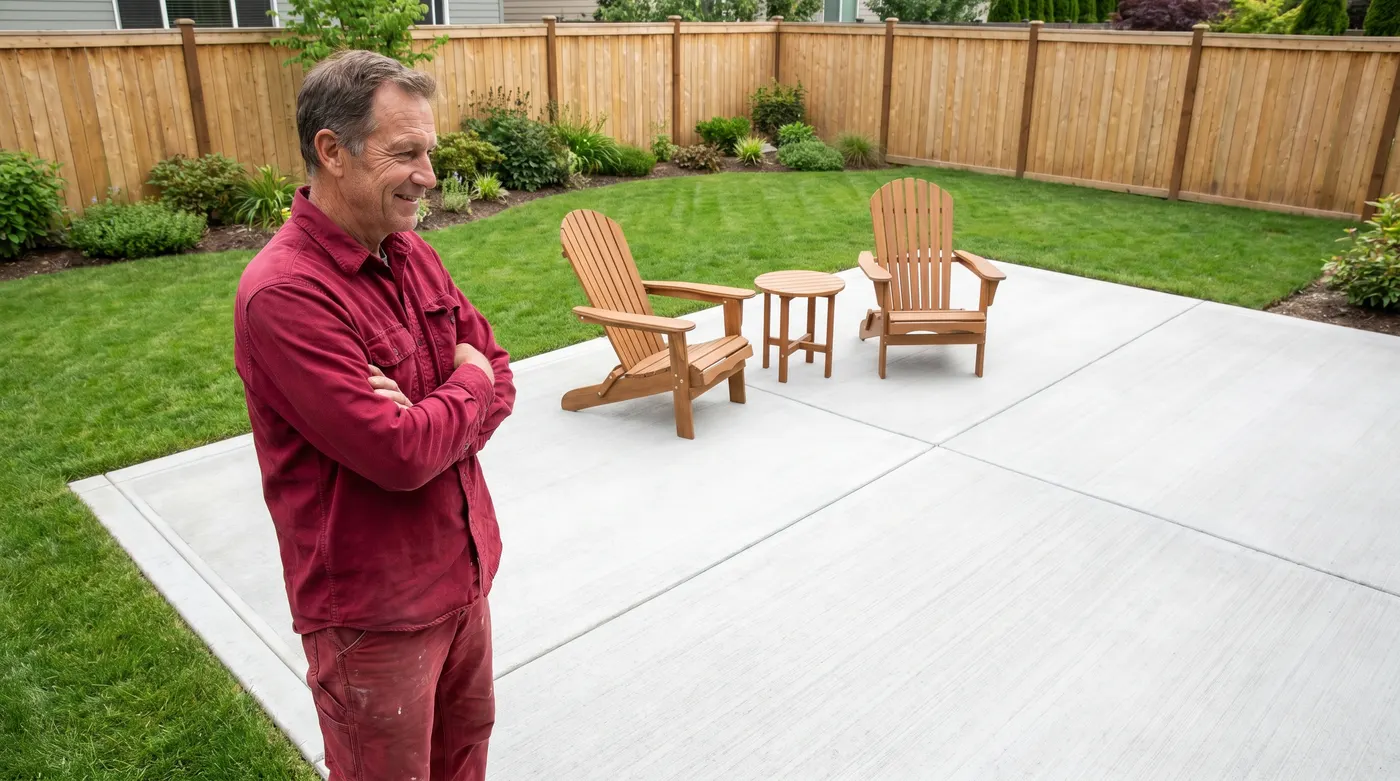
Broom finish fits budgets and pure function - maximum traction, lowest cost, easiest future repair. Stamped concrete fits homeowners who want the slate, flagstone, or brick look at half of natural-stone cost; the trade-off is resealing every 2-3 years to hold the color. Integral color without stamping splits the difference: warmer than gray, no pattern maintenance. Exposed aggregate fits pool surrounds where wet-foot slip resistance matters most.
Pool Decks Are Their Own Spec
A pool deck is not a patio next to water - it needs slip resistance (broom, exposed aggregate, or textured stamp), a drainage slope away from the shell, and expansion joints where deck meets coping, because deck and pool move differently through freeze-thaw. BG Concrete pours decks with all three written into the quote.
Drainage Decides Whether a Patio Behaves
A patio should slope away from the house at roughly 1/8 inch per foot, with joints placed so water does not sit against the foundation or collect at the door threshold. Patios that look flat on day one often become spring problems when meltwater has nowhere to go. The quote should name the slope direction before forms are set.
Finish Choice Should Match Use
Broom finish fits grills, dining sets, and everyday traffic because it is predictable and easy to maintain. Stamped finish fits visible entertaining spaces when the owner accepts resealing as part of ownership. Exposed aggregate fits wet traffic around pools. The wrong finish is usually a maintenance problem, not an installation problem.
How big should the patio be? A dining set needs about 12x12; dining plus a lounge zone wants 16x20 or larger.
When can furniture go on it? Light furniture after 7 days; hold heavy planters and hot tubs for 28.
Stamped patios carry their own playbook - patterns, color systems, and realistic maintenance - covered on the stamped concrete patios page.
Free Same-Week Patio Estimate - 630-595-1518
Common Questions Before You Call
What makes a patio perform?
A patio performs when it is pitched away from the house, placed on compacted stone, jointed correctly, and finished for the way it will be used. Grill pads, furniture zones, hot tubs, and steps all change thickness, reinforcement, or layout decisions.
What should be decided before forms go in?
Decide size, elevation, door transitions, step layout, drainage direction, finish, border, and future add-ons before the pour. Concrete is not easy to move after placement, so layout work matters as much as finishing.
When is plain better than decorative?
Plain broom finish is better for low-maintenance utility spaces. Decorative finishes are better for visible entertainment areas where the owner accepts resealing and more careful winter maintenance.
How should bids be compared?
Compare the total price against the written method, base or drainage correction, thickness where relevant, disposal, access limits, cure timing, and what is included. The better bid is the one that names the work that prevents failure, not the one with the lowest unexplained budget number.
Want proof before you call? Browse examples of our finished patios and read what Chicagoland homeowners say about working with B.G. Concrete.
Related Patios Guides
More guides on patios: Plain patios, stamped finishes, drainage slope, backyard access, color, sealer, and maintenance.